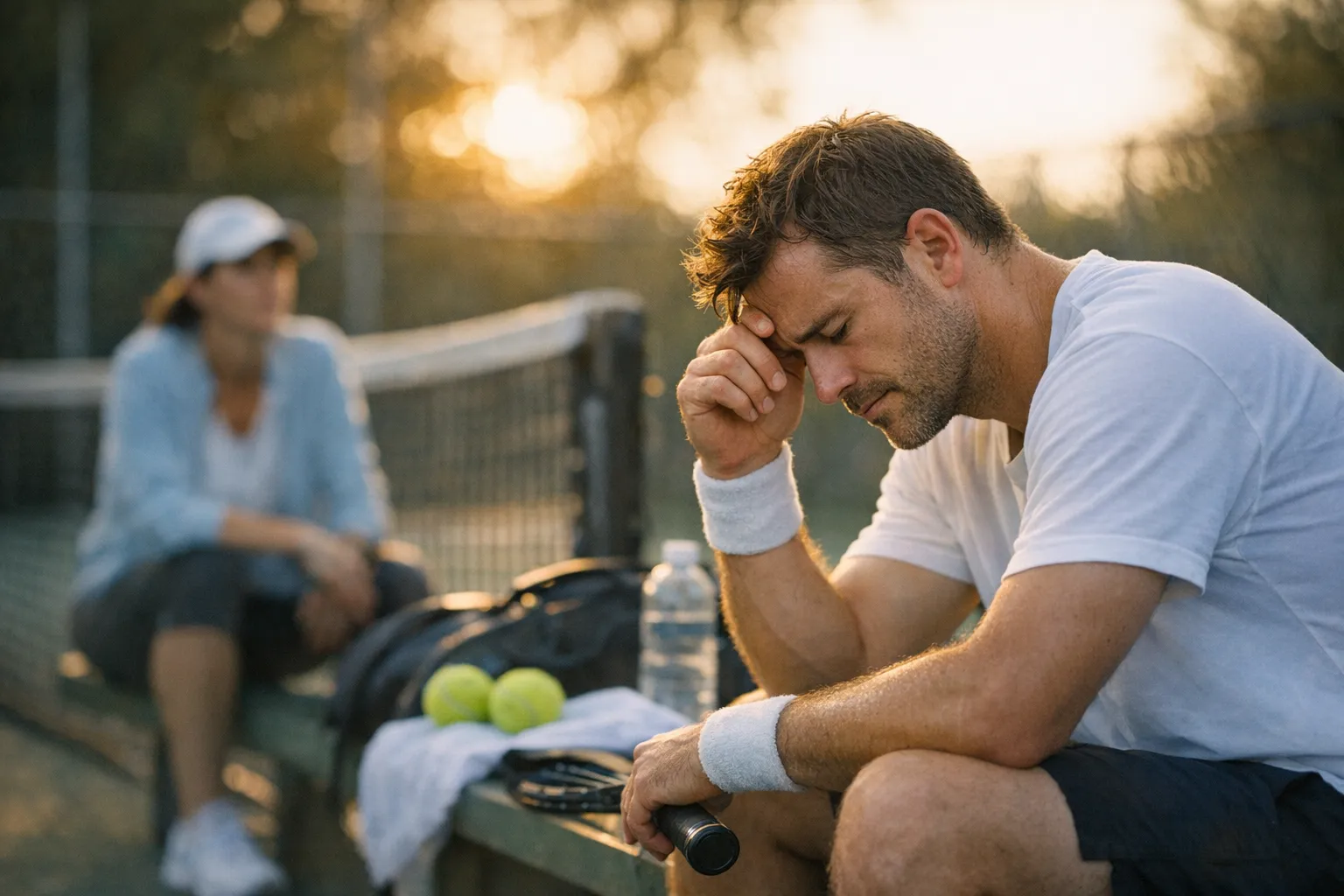
How to Use Personal Psychology to Perform Better on the Tennis Court
Tennis makes psychology visible. One point can feel calm and clear; the next can bring tight shoulders, rushed decisions, negative self-talk, or a sense that everything is slipping away. That is part of why tennis is such a useful example for understanding performance. The physical skills matter, of course, but what happens inside your mind and body often determines whether those skills show up when you need them.
For many people, sport is not separate from the rest of life. The same patterns that shape your relationships can also shape your game: perfectionism, fear of disappointing others, difficulty recovering from mistakes, harsh self-criticism, or trouble staying grounded under pressure. Learning your personal psychology does not just help you compete better. It can also help you become more steady, more self-aware, and more compassionate in the relationships that matter most.
If this topic resonates, Strong & Connected offers support for both performance and relationships, including work for athletes, for couples, and consultations for people wanting practical next steps.
Why psychology matters so much in tennis
Tennis is psychologically demanding because there are frequent resets, long pauses, momentum swings, and nowhere to hide when your confidence dips. Unlike some team sports, you cannot easily hand the moment to someone else. You have to regulate yourself point by point.
Research in sport psychology consistently shows that performance is shaped by attention, arousal regulation, confidence, self-talk, and emotional control. Helpful starting points include the American Psychological Association overview of sport and exercise psychology and the National Library of Medicine’s research database, where you can explore studies on attention, pressure, stress, and athletic performance.
But psychology is not only about “mental toughness.” That phrase can become misleading if it encourages suppression, shame, or grinding through distress without awareness. Real mental strength is often quieter than that. It includes noticing what is happening, regulating your nervous system, staying flexible, and returning to the next point without turning one mistake into a full internal collapse.
For a deeper look at the athletic mental game, you may also appreciate A Practical Mental Game Playbook for Better Sports Performance, The Quiet Mind Advantage: How an Athlete’s Mental State Shapes Performance, and Why Psychological Training Matters as Much as Physical Training.
Start with your personal performance pattern
Most athletes do not struggle in random ways. They tend to have a pattern. Understanding that pattern is one of the fastest ways to improve.
Common patterns that show up on the court
- Perfectionism: You play well until one error convinces you that you are failing.
- Fear-based caution: You stop swinging freely when the score gets tight.
- Over-activation: Your body gets too amped up, and your timing disappears.
- Under-activation: You feel flat, distracted, or emotionally absent.
- Harsh self-talk: You speak to yourself in ways you would never speak to someone you love.
- Externalized pressure: You feel preoccupied with what a coach, parent, partner, or opponent thinks of you.
- Collapse after mistakes: One bad game becomes three because you cannot reset.
Your first task is not to eliminate these patterns instantly. It is to recognize them early and respond more skillfully.
Use self-awareness, not self-attack
A lot of athletes assume insight means criticizing themselves harder. Usually, that backfires. Shame narrows attention and makes performance less flexible. Self-awareness works better when it is clear and non-dramatic.
After a match, ask:
- What happened in my body when I got tight?
- What story did I start telling myself?
- What did I do after mistakes?
- Did I rush, avoid, overthink, or withdraw?
- What actually helped me settle?
This kind of reflection builds accuracy. Accuracy is more useful than intensity.
There is also a strong relationship here to emotional intelligence. If you can identify your internal state with more precision, you can respond more effectively. That same skill helps in relationships, especially under stress. For related reading, see Building Emotional Intelligence for Stronger Relationships and Emotions and Feelings for Men and Boys: A Practical Guide to Naming What’s Going On and Strengthening Relationships.
A practical tennis example: from spiral to reset
Imagine a player named Alex serving at 4-4. Alex double-faults, misses an easy forehand, and immediately thinks, “I always choke.” His breathing gets shallow. He rushes between points. He starts trying not to miss instead of trying to play well. Within minutes, his game shrinks.
The technical problem may look like serving or footwork, but the deeper issue is psychological. Alex has fused with a threat story. His body is reacting as if the match now proves something painful about him.
A healthier response might look like this:
- Name the reaction: “I am tight and frustrated.”
- Regulate the body: One longer exhale, loosen the jaw, drop the shoulders.
- Narrow the focus: “High first-serve margin. Heavy crosscourt. Move my feet.”
- Use functional self-talk: “One point. Compete here.”
- Accept imperfection: “Nerves are here. I can still play.”
That sequence does not guarantee a win. It does increase the chance that Alex returns to the present instead of fighting himself. In performance settings, that shift is often decisive.
Five psychological skills that improve tennis performance
1. Build a between-point routine
Routines reduce mental drift and help your nervous system recover. A simple between-point routine might include turning away from the net, one calming breath, a physical cue like adjusting strings, and one clear tactical intention for the next point.
The goal is not superstition. It is regulation and consistency.
2. Train your self-talk
Under pressure, many people become internally abusive. That usually increases tension and reduces adaptability. Replace global attacks like “I’m terrible” with useful prompts such as “legs moving,” “see the ball,” or “commit to the target.”
This is not forced positivity. It is performance-relevant language.
3. Learn your optimal activation level
Some players perform best when energized. Others need a calmer internal state. Notice whether you tend to overheat or flatten out. If you get too activated, lengthen your exhale and slow your pace between points. If you get flat, use movement, a sharper cue word, or more assertive footwork to lift your intensity.
4. Separate identity from outcome
One of the biggest psychological traps in tennis is turning results into a verdict on your worth. When that happens, pressure spikes. You are no longer just playing a match; you are defending yourself.
Performance improves when you care deeply about competing while holding the result more lightly. This mindset is also healthier in intimate relationships, where overidentifying with success, failure, or approval often creates rigidity and conflict.
5. Practice recovery after mistakes
The best competitors are not mistake-free. They are recovery-skilled. A missed shot is part of tennis. The question is whether you add a second and third error through frustration, panic, or self-punishment.
You can rehearse recovery in practice: intentionally play pressure games, notice your reaction after mistakes, and train a reset routine until it becomes more automatic.
What tennis can teach us about relationships
This may seem like a sports article, but the overlap with relationships is real. Many people bring the same nervous-system patterns into competition and connection.
- If you become harsh and blaming after a tennis mistake, you may also become harsh and blaming during conflict.
- If you shut down after a lost game, you may also withdraw after relational disappointment.
- If you need constant external validation on the court, you may seek it in ways that strain intimacy.
- If you can pause, regulate, and re-engage in tennis, you can build that capacity in conversations too.
That is part of why therapy-informed coaching can be so useful. Improving performance is not just about strategy. It is also about understanding the emotional habits underneath strategy.
If you are navigating pressure in both sport and close relationships, these articles may help: Building Emotional Strength in Relationships, Building Stronger Relationships Through Effective Communication, and How to Support Your Kids in Sports Without Damaging Your Relationship.
How early experiences can affect your game
Personal psychology does not appear out of nowhere. Sometimes your response to pressure reflects older experiences: criticism, conditional approval, family instability, or a sense that mistakes were unsafe. On court, those old dynamics can get activated fast.
For example, an athlete who grew up equating love with achievement may become especially distressed by errors. Another athlete may avoid assertive play because taking risks once led to criticism. Understanding these links can bring relief. It helps you stop treating your reactions as proof that something is wrong with you and start seeing them as learned patterns that can change.
This broader lens is explored in Why Our Early Years Still Shape Us as Adults—and How to Move Beyond Old Patterns.
External resources worth exploring
If you want to learn more about psychology and performance from evidence-based sources, these are useful places to start:
- American Psychological Association: Sport and Exercise Psychology
- PubMed Central: Research on sport psychology, stress, and performance
- Frontiers in Psychology: Performance Science
These resources can help you separate solid ideas from oversimplified mental-performance advice.
A simple weekly mental training plan
If you want to start using personal psychology more intentionally, keep it simple:
- Before play: Set one mental goal, such as “reset quickly after errors.”
- During play: Use the same between-point routine every time.
- After play: Write down one trigger, one body cue, and one thing that helped.
- Once a week: Reflect on your deeper pattern. Was it perfectionism, fear, anger, collapse, or distraction?
- In daily life: Notice where the same pattern shows up in work or relationships.
This kind of repetition builds durable change because it connects performance skills with self-understanding.
When support can help
Sometimes athletes know what to do but struggle to do it consistently under pressure. That can be a sign that the issue is not just tactical. It may involve anxiety, identity, shame, relationship stress, or long-standing emotional patterns. Working with a skilled professional can help you understand what keeps hijacking your game and how to respond differently.
Strong & Connected works from a practical, emotionally intelligent lens that respects both performance and the person underneath it. If you want help improving how you handle pressure on the court, or how similar patterns affect your relationship, you can explore support for athletes, learn more about the approach, or book a consultation.
You do not need to become a different person to compete better. Often, the real work is learning to know yourself more clearly, steady yourself more skillfully, and return to the next point with a little more freedom.
If you are ready to strengthen both performance and connection, reach out for a consultation. Calm, practical support can make a real difference.
Frequently Asked Questions
How does psychology affect tennis performance?
Psychology affects focus, confidence, emotional regulation, recovery after mistakes, and how well your physical skills show up under pressure.
What is the best mental strategy to use between tennis points?
Use a short reset routine: turn away, take one steady breath, relax your body, and choose one simple intention for the next point.
Can self-talk really improve sports performance?
Yes. Useful self-talk can steady attention and reduce spirals. It works best when it is specific, calm, and focused on the next action.
Why do I play well in practice but struggle in matches?
Matches bring more pressure, self-consciousness, and nervous-system activation. Often the issue is not skill alone but how you respond internally when the stakes feel higher.
Can working on sports psychology also help my relationships?
Often, yes. Skills like emotional awareness, regulation, flexibility, and recovery after mistakes can support both better performance and healthier communication.