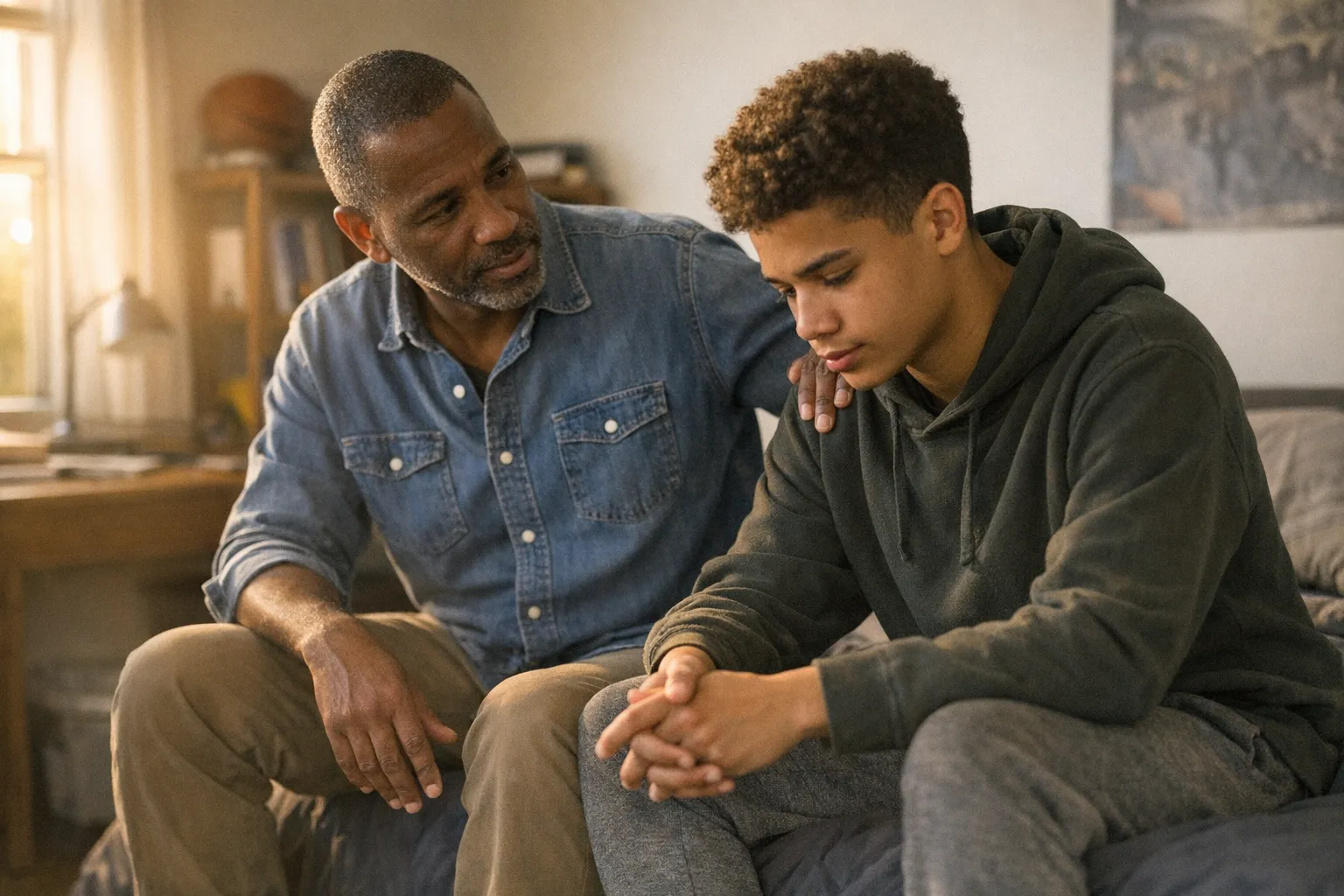
Emotions and Feelings for Men and Boys: A Practical Guide to Naming What’s Going On and Strengthening Relationships
Many men and boys grow up receiving a narrow emotional education. They may be told to toughen up, calm down, stop overreacting, or handle things on their own. Often, the message is not simply “don’t cry.” It is broader: be competent, be in control, do not need too much, and do not show vulnerability unless it is socially approved. The cost of that training can be high.
When emotional life gets reduced to a few acceptable states, many boys and men learn to speak in only a limited range: fine, stressed, angry, tired, good. But underneath those words may be disappointment, embarrassment, loneliness, fear, grief, longing, shame, tenderness, and hope. When inner experience stays unnamed, it does not disappear. It often comes out sideways through irritability, withdrawal, overwork, defensiveness, numbness, conflict, or a sense of distance from the people who matter most.
The encouraging news is that emotional literacy can be learned. Research-informed work from Marc Brackett emphasizes that recognizing, understanding, labeling, expressing, and regulating emotion are practical skills, not personality traits you either have or do not have. Terry Real’s work adds another crucial piece: many men have been shaped by a culture that teaches disconnection from vulnerability, and that disconnection affects intimacy, self-worth, and relational honesty. Put simply, emotions matter because relationships matter.
For couples, this is not a soft extra. It is core relationship work. If you can notice what you feel, name it accurately, and share it without blame, you are more likely to be understood, less likely to escalate, and better able to repair after conflict. If you are a father, coach, teacher, or partner, your emotional skills also shape the emotional world around you. Boys learn not only from what we say, but from what we model.
If this is an area you want to strengthen, our work with men, boys, and couples is designed to be practical, grounded, and relational.
Why emotions can feel hard for men and boys
It is common for men to say, “I don’t know what I’m feeling,” when what they often mean is, “I was never taught how to identify it safely,” or “I learned there was a cost to showing it.” For boys, the social rules can start early. Some feelings are accepted if they look strong, action-oriented, or detached. Others may be criticized, ignored, or treated as weakness.
Terry Real has written and taught extensively about how boys are often pressured to disconnect from softer emotions in order to fit into conventional masculinity. That can include sadness, fear, tenderness, hurt, dependency, and shame. The result is not that these feelings vanish. The result is that they become harder to recognize and harder to share. Many men then default to the emotions that remain permissible, especially anger, competitiveness, sarcasm, or silence.
Marc Brackett’s work helps frame this clearly: if you cannot accurately identify what you feel, it becomes much harder to regulate it well. A man who says he is angry may actually be feeling dismissed, anxious, ashamed, overwhelmed, or alone. Those are not small differences. If you respond to shame as though it were only anger, you will likely protect yourself by attacking, avoiding, or shutting down. If you recognize that what is happening is hurt or fear, you have more options.
This is one reason emotional vocabulary matters. Better language creates better choices. Better choices create better relationships.
Emotions versus feelings: what is the difference?
In everyday conversation, people often use these terms interchangeably, and that is fine. But it can help to make a simple distinction. Emotions are the mind-body responses that arise in reaction to what is happening within us and around us. Feelings are the conscious experience of those emotions, the part we can notice and describe.
For example, your body may tighten when your partner’s tone changes. Your chest may feel heavy. Your thoughts may speed up. Emotion is already moving through you. Once you notice it and put words to it, you might say, “I’m feeling anxious,” or “I’m feeling criticized,” or “I’m feeling small right now.”
That pause matters. It turns reactivity into awareness.
For boys especially, this can be taught in concrete ways. Instead of asking only, “What happened?” it can help to ask, “What did you notice in your body?” “What feeling word fits best?” “What do you need right now?” These are not abstract questions. They build emotional intelligence over time.
What happens when feelings stay unnamed
When emotional life is restricted, several patterns often show up.
- Anger becomes the spokesperson for every feeling. Hurt, fear, rejection, shame, and disappointment may all come out as irritation or criticism.
- Withdrawal replaces communication. Instead of saying, “I feel overwhelmed and I need a minute,” a person goes silent, leaves, or disconnects.
- Partners feel shut out. One person may say, “I have no idea what is going on with him,” while the other feels misunderstood and pressured.
- Boys may act out what they cannot say. Emotional distress can show up as aggression, risk-taking, school problems, defiance, or seeming not to care.
- Shame grows in secrecy. When someone does not have language for vulnerability, they may assume they are failing rather than struggling.
These patterns are not signs of bad character. They are often signs of underdeveloped emotional skills mixed with learned self-protection. That distinction matters because it creates room for growth without shame.
A practical framework: notice, name, make sense, choose
Drawing from Brackett’s emotional intelligence approach and the direct, relational honesty emphasized by Terry Real, a useful practice is this: notice, name, make sense, choose.
1. Notice
Start with your body and behaviour. Are your shoulders tight? Jaw clenched? Breathing shallow? Do you want to argue, leave, defend, or fix? Emotional awareness often begins physically, not verbally.
2. Name
Use more precise language than fine, mad, or stressed. Try words like disappointed, uneasy, embarrassed, left out, ashamed, pressured, lonely, discouraged, relieved, hopeful, affectionate, or grateful. Accuracy helps.
3. Make sense
Ask yourself, “What is this feeling about?” Did something touch an old bruise? Do you feel dismissed, not good enough, trapped, powerless, or afraid of letting someone down? Terry Real’s work often invites people to go beneath the surface reaction and look at the vulnerability underneath. That is where honesty begins.
4. Choose
Once you know more clearly what is happening, choose a response that serves the relationship and your own integrity. That might mean speaking up calmly, asking for time, setting a boundary, offering repair, or simply saying what is true without attack.
An example: instead of, “You’re always on my case,” it may sound like, “When I heard that, I felt embarrassed and defensive. I know I got sharp. Can we slow this down?” That kind of language is not weak. It is regulated, accountable, and relationally strong.
How this shows up in couple relationships
In intimate relationships, limited emotional language can create repetitive conflict. One partner may pursue with questions or criticism. The other may defend, shut down, or get angry. Beneath that pattern, there is often something more tender: fear of failure, fear of being controlled, fear of not mattering, or old shame getting activated.
Terry Real’s relational work is especially useful here because it does not stop at insight. It asks for mature love: truth, accountability, respect, and repair. That means not only understanding your feelings, but learning how to bring them into the relationship in a way that is honest and non-punitive.
For example, there is a difference between saying, “You never appreciate me,” and saying, “I noticed I’ve been getting critical. Underneath that, I think I’ve been feeling unappreciated and lonely.” The second statement is more vulnerable, more accurate, and more workable.
If conflict is frequent, you may also find support in How to Stop Fighting in a Relationship and How to Repair After a Fight in 10 Minutes - Using RLT strategies.
How to help boys build emotional strength without shame
Boys do not need fewer emotions. They need safer and better ways to understand them. Emotional strength is not the absence of feeling. It is the ability to stay connected to yourself and others when feelings arise.
Here are a few practical ways parents, caregivers, coaches, and mentors can help:
- Normalize the full range of emotion. Let boys know that sadness, fear, embarrassment, jealousy, excitement, and tenderness are part of being human.
- Teach language early and often. Offer feeling words in everyday moments, not just during crises.
- Respond to emotion before correcting behaviour. Accountability matters, but regulation comes first. A dysregulated child rarely learns well from lectures.
- Model emotional honesty. Adults can say, “I’m frustrated, and I’m going to take a breath,” or “I felt hurt, and I want to talk respectfully.”
- Avoid shaming phrases. Statements like “man up” or “don’t be so sensitive” often teach disconnection, not resilience.
This is especially important in families where boys are trying hard to appear unaffected. Often, the goal is not to force disclosure. It is to create enough safety that emotional truth becomes possible.
If you are a man who was never taught this
You are not behind. You may simply be unpracticed. Many capable, intelligent, loving men were trained to perform steadiness while losing touch with their inner life. That can leave you strong in achievement and weak in emotional translation. It can also make close relationships feel confusing or exhausting.
The work is not to become endlessly emotional. The work is to become more accurate, more honest, and more connected. Start small. Once or twice a day, ask yourself:
- What am I feeling right now?
- What is this feeling about?
- What do I need?
- How can I express this without blame?
If you are in a relationship, try one simple sentence a few times a week: “What I’m feeling is…” followed by one specific emotion and one brief reason. This may feel awkward at first. That is normal. New skills often do.
You may also appreciate related reading on men's mental health, Building Emotional Intelligence for Stronger Relationships, and Terry Real and the History of Relational Life Therapy.
When support can help
Sometimes emotional growth happens through reflection, practice, and conversation. Sometimes it helps to work with someone who can slow the process down, notice patterns, and help translate conflict into something more workable. That can be especially helpful if emotions quickly turn into anger, shutdown, shame, or repeated couple conflict.
Coaching or therapy can support men, boys, and couples in learning how to identify emotions, communicate more clearly, and build stronger relational habits. If you are wondering what approach fits best, you can read more at Coaching vs Therapy, What to Expect, and What is RLT?.
Emotional intelligence is not about becoming fragile or overfocused on feelings. It is about becoming more grounded, less reactive, and more capable of real closeness. For men and boys, that can be life-changing. For couples, it can change the tone of a relationship from guarded and repetitive to open, respectful, and repairable.
If you want support building these skills in yourself, your relationship, or your family, book a consultation. We can talk about what is happening and what kind of support would be most useful.
Frequently Asked Questions
Why do many men have trouble identifying their feelings?
Many men were socialized to limit or hide vulnerable emotions. That does not mean they lack feelings. It usually means they were not taught safe language or practice for recognizing and expressing them.
What is the difference between emotions and feelings?
Emotions are your mind-body responses to what is happening. Feelings are the part you consciously notice and can describe with words like anxious, hurt, ashamed, or relieved.
How can I help a boy talk about his emotions without pressuring him?
Stay calm, use simple feeling words, and ask concrete questions such as what he noticed in his body or what happened right before the reaction. Focus on safety and curiosity rather than forcing him to open up.
Can improving emotional intelligence help my relationship?
Yes. When you can notice, name, and express feelings more accurately, conflict tends to become less reactive and communication becomes clearer, more respectful, and easier to repair.
When should a man or couple get support for emotional communication?
Support can help when emotions regularly turn into anger, shutdown, defensiveness, distance, or recurring arguments. It can also help if you want practical tools for building trust and connection before things get worse.