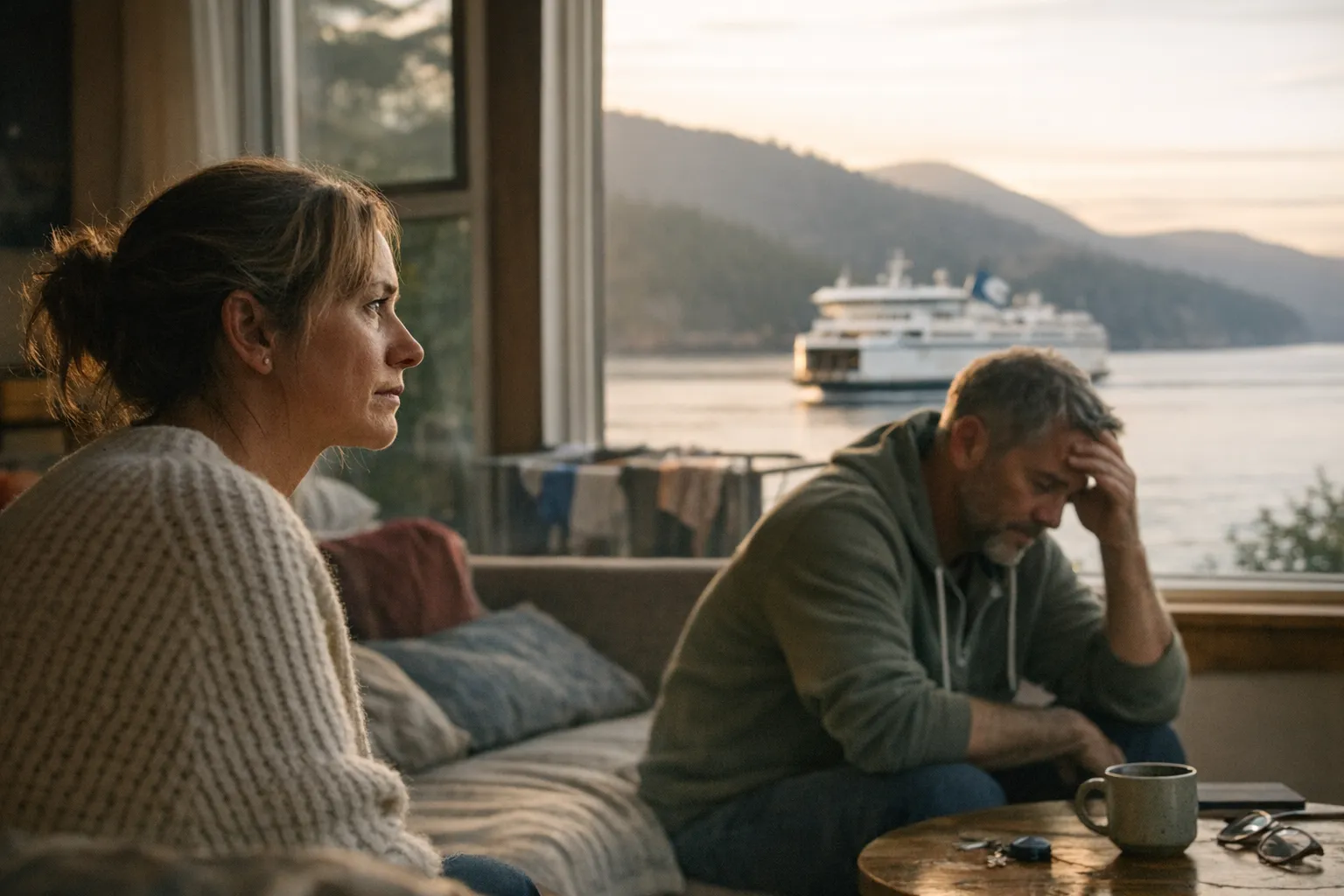
Island life can be beautiful and demanding at the same time
Life on Vancouver Island and the smaller islands off the coast of British Columbia can feel deeply appealing: ocean air, stronger ties to place, quieter communities, and a pace that often feels more human than urban life. For many couples and individuals, that lifestyle supports meaningful connection. It can invite presence, family time, and a sense of belonging that is harder to find in larger cities.
And at the same time, island life can put real pressure on relationships.
When people imagine relational stress, they often think of obvious issues like parenting conflict, finances, communication breakdowns, or trust injuries. Those matter. But environment matters too. Where you live shapes your routines, stress load, support system, access to help, and the amount of flexibility you have when life gets hard.
On Vancouver Island, the Gulf Islands, and other coastal island communities, couples may be navigating ferry schedules, weather disruptions, housing costs, seasonal work, limited childcare, long waits for services, medical travel, and the reality of living in a place where privacy can be hard to come by. None of this means island life is bad for relationships. It means the setting comes with its own emotional and practical demands.
If you and your partner feel more reactive, isolated, or stretched than you expected, there may be nothing “wrong” with your relationship in the dramatic sense. You may be responding to a real environment that asks a lot of you.
This article looks at some of the unique relationship challenges of island living, using Vancouver Island and nearby islands as examples, and offers grounded ways to respond with more teamwork and less blame.
Why island living affects relationships more than people often expect
Relationships do not happen in a vacuum. Stress researchers have long noted that chronic external pressure can reduce patience, flexibility, and emotional regulation. When daily life becomes logistically difficult, people tend to have less bandwidth for empathy and repair. Small frustrations accumulate. Conversations become more transactional. Resentment can grow quietly.
Island living can create exactly this kind of background strain. A missed ferry can derail a whole day. A specialist appointment may require significant travel. Housing insecurity can make long-term planning feel shaky. Winter storms can reduce mobility and increase isolation. If one partner carries more of the planning, commuting, or emotional labour, the imbalance can become a recurring source of conflict.
In other words, the relationship may be absorbing stress that actually begins outside the relationship.
That is an important distinction. It helps couples move from “you are the problem” toward “this is the pressure we are under, and how do we face it together?” That shift alone can lower defensiveness and create more room for practical problem solving.
1. Ferry dependence can create chronic stress and resentment
For many people on Vancouver Island and the Gulf Islands, ferry travel is not a novelty. It is part of daily or regular life. That reality affects work schedules, medical access, family visits, sports travel, education, and even grocery planning.
BC Ferries is essential infrastructure for many coastal residents, but ferry dependence can be emotionally expensive. Delays, cancellations, long waits, reservation worries, and the cost of frequent travel can add strain to already full lives. If one partner travels often for work or carries the burden of coordinating family logistics, that stress can become relational.
How this stress tends to show up in relationships
- Arguments about time, punctuality, or planning
- One partner feeling they carry the “mental load” of travel coordination
- Disappointment when visits with family or friends fall through
- Reduced spontaneity and a sense that everything requires effort
- Tension about the financial cost of leaving the island regularly
Over time, a practical problem can turn into a story about character: “You never think ahead,” “You always make us late,” or “I’m the only responsible one.” That is when couples start fighting each other instead of the actual issue.
A healthier approach is to treat transportation strain as a shared systems problem. Create routines together: who books, who checks sailing conditions, what backup plans exist, and how you will respond when plans change. The goal is not perfection. It is reducing avoidable friction.
Useful local information can be found through BC Ferries, including service notices, reservations, and travel updates.
2. Limited access to services can leave couples feeling alone
Many island communities have fewer nearby services than large urban centres. That can include healthcare, mental health support, childcare, specialized education, legal services, and recreational programming. Even on Vancouver Island, access can vary significantly depending on whether you live in Greater Victoria, Nanaimo, the Comox Valley, Port Alberni, Campbell River, or a smaller rural area. On the Gulf Islands, the gap can feel even sharper.
When support is limited, ordinary life stress becomes harder to buffer. A parent with no childcare backup gets less rest. A couple waiting months for help may become more discouraged. A person already dealing with anxiety or depression may feel more isolated if there are fewer nearby options.
This matters relationally because overwhelmed people are usually less available to one another. They may be short-tempered, withdrawn, or discouraged. They may stop having the kinds of conversations that sustain closeness.
What helps
- Name the reality without minimizing it: limited access really does affect your relationship
- Use telehealth and online support where appropriate to reduce geographic barriers
- Build a small, reliable support circle rather than waiting for a perfect system
- Talk directly about burnout before it turns into contempt or shutdown
For some couples, online support creates much-needed consistency. If that is relevant for you, you can learn more about online coaching and what it can look like in practice.
Local and regional mental health information is available through Island Health Mental Health and Substance Use Services. In a crisis, 310-6789 Mental Health Support offers support across British Columbia without needing an area code.
3. Housing pressure and cost-of-living stress can intensify conflict
Across much of coastal British Columbia, housing pressure is not just an economic issue. It is a relationship issue. On Vancouver Island, many individuals and couples are dealing with high home prices, rising rents, low vacancy, renovation challenges, commuting trade-offs, and difficult decisions about whether to stay, move, rent longer, or live in multigenerational arrangements.
On smaller islands, housing supply can be even tighter. Seasonal tourism, second-home ownership, and limited rental inventory may create a sense of instability. Even couples who deeply love island life can find themselves under significant financial pressure.
Money stress changes how people talk. It can make one partner more controlling, the other more avoidant, or both more anxious. It often narrows emotional generosity.
Common patterns couples fall into
- One partner becomes hyper-focused on budgets and the other feels criticized
- Future planning becomes tense or repetitive
- Partners stop discussing fears openly and instead argue about surface issues
- Shame increases when people compare themselves to wealthier neighbours or newcomers
What helps here is less blame and more transparency. Talk about the numbers, but also talk about the feelings attached to the numbers: fear, grief, embarrassment, disappointment, and hope. Couples often communicate better when they realize they are not only arguing about dollars, but about safety, identity, and the future.
If money stress is leading to repetitive fights, a structured communication approach can help. You may find Building Stronger Relationships Through Effective Communication and How to Stop Fighting in a Relationship useful starting points.
4. Small-community dynamics can make privacy and boundaries harder
One of the strengths of island living is community. People know each other. They check in. They show up. That can be deeply supportive.
But close-knit communities can also make relationships more complicated. On Vancouver Island in smaller towns, and especially on the Gulf Islands, there can be a real sense that everyone knows everyone. Ex-partners may remain in the same social circles. News travels quickly. Family conflict may not stay private for long. If you are going through a rough patch, separation, or public disagreement, the lack of anonymity can add another layer of strain.
This can also make boundary-setting harder. People may feel pressure to attend community events, stay connected with difficult relatives, or maintain appearances. Some couples become more performative in public and less honest in private. Others start triangulating, pulling friends, family, or neighbours into relationship tension instead of addressing it directly.
That dynamic is worth watching. If conflict is being managed through third parties, the relationship usually becomes less stable, not more. If this pattern feels familiar, Triangulation in Relationships: Why It Hurts Conflict and What to Do Instead may help you put language to what is happening.
Practical boundary questions for island communities
- Who gets to know about our conflicts, and who does not?
- What parts of our life are private even in a close community?
- How do we stay respectful at public events when we are under strain?
- What support is helpful, and what becomes intrusive?
5. Weather, darkness, and winter isolation can affect mood and connection
People who live on or near the coast know that beauty and hardship often arrive together. The marine climate can be soothing, but extended rain, wind, storms, and winter darkness can also affect energy, mood, and social life. Travel may be more difficult. Outdoor routines change. Plans get canceled. People spend more time indoors and, at times, more time on top of each other.
For couples already carrying unresolved tension, winter can intensify disconnection. One person may want closeness while the other wants more space. Cabin-fever irritability can lead to fights that feel bigger than the actual trigger. For individuals living alone, island winters can deepen loneliness, especially if social circles are small or transportation is limited.
None of this should be dramatized, but it should be taken seriously. Emotional regulation is harder when people are under-slept, under-socialized, and spending less time in movement and daylight.
Supportive winter habits
- Protect routine as much as possible
- Schedule connection instead of waiting to feel spontaneous
- Move your body, even briefly, most days
- Talk early about mood changes rather than silently withdrawing
- Use light, social contact, and structure proactively
If stress and anxiety increase during hard seasons, The Importance of Self Care: Essential for Emotional Health may offer a practical next step.
6. Distance from family can create both freedom and grief
Many people move to Vancouver Island or the Gulf Islands for lifestyle reasons, work, retirement, or a fresh start. Sometimes that move brings relief. It can create needed distance from family conflict, urban overload, or a life that no longer fits.
But distance can also bring grief. Grandparents are farther away. Emergency support is less immediate. Parenting without extended family nearby can be exhausting. If one partner feels more rooted in island life than the other, the gap can become emotionally significant.
A common hidden conflict sounds like this: one person says they love the island, while the other says they miss ease, options, and proximity. Underneath that disagreement are often deeper questions: Where is home? Whose preferences matter more? What are we sacrificing, and is it worth it?
These are not small questions. They deserve slow, respectful conversations rather than repeated practical arguments.
7. Island identity can make it harder to admit you are struggling
Many island communities value resilience, self-reliance, and adaptability. Those qualities can be strengths. But they can also become a barrier when people start telling themselves they should be coping better than they are.
Couples may think, “We chose this lifestyle, so we shouldn’t complain.” Individuals may feel guilty admitting that the beauty around them does not erase loneliness, financial stress, or burnout. This can create a painful mismatch between outer appearance and inner reality.
You can be grateful for where you live and still acknowledge that it is hard on your nervous system, your routines, or your relationship.
That kind of honesty is not weakness. It is usually the beginning of repair.
How couples can protect their relationship while living on an island
Island stress does not need to define your relationship. But it does help to be intentional. Couples tend to do better when they stop assuming that love alone will carry the logistics, pressure, and accumulated fatigue of daily life.
Five grounded practices that help
- Externalize the pressure. Instead of “you are making this hard,” try “we are under a lot of strain from travel, cost, isolation, and limited support.” This reduces blame and invites teamwork.
- Create systems for recurring stressors. Use shared calendars, ferry routines, backup childcare plans, budget check-ins, and explicit household roles. Repeated chaos is hard on intimacy.
- Address resentment early. Resentment grows fastest when one person feels over-responsible and under-appreciated. Say it sooner, and say it cleanly.
- Protect connection on purpose. Date nights do not have to be elaborate. A walk, tea after the kids are asleep, or twenty minutes without screens can help maintain contact.
- Get support before things become severe. You do not have to wait for a crisis. Early support is often more effective and less painful.
If you are wondering what kind of help fits your situation, Coaching vs Therapy, For Couples, and What to Expect may help you orient.
Local resources for Vancouver Island and nearby island residents
If island life is affecting your mental health or relationship, local support matters. These resources may be a useful place to begin:
- Island Health Mental Health and Substance Use Services
- BC Ferries for travel planning and service notices
- Canadian Mental Health Association BC Division
- Here to Help BC for mental health and substance use information
- 310-6789 Mental Health Support
- Canadian Mental Health Association, BC Division - Victoria branch
If you need immediate emergency support, call 911 or go to your nearest emergency department.
A final thought
Living on Vancouver Island or the surrounding islands can be deeply nourishing. It can also expose pressure points in a relationship that might stay less visible elsewhere. The goal is not to pathologize island life. It is to recognize that beautiful places can still be hard places to build a life.
If you and your partner are feeling the strain, try not to turn that strain into a character verdict about each other. Look at the context. Slow things down. Name what is hard. Build better systems. Ask for support sooner.
If you would like a calm, practical place to talk through what island life is bringing up in your relationship, book a consultation. You do not need to wait until things fall apart.
Frequently Asked Questions
How can living on Vancouver Island affect a relationship?
Island living can add pressure through ferry dependence, limited services, housing costs, weather-related isolation, and distance from family. These stressors can reduce patience and increase conflict if couples do not address them openly.
Why do couples fight more when daily logistics are hard?
When people are overloaded, they have less emotional bandwidth. Travel planning, financial strain, childcare gaps, and disrupted routines can make small issues feel bigger and lead partners to blame each other instead of the stress around them.
What are common relationship challenges in small island communities?
Privacy can be harder to maintain, social circles often overlap, and boundaries with friends or family may feel less clear. This can increase pressure, especially during conflict, separation, or major life changes.
Can online relationship support help people living on Vancouver Island or the Gulf Islands?
Yes. Online support can reduce travel barriers and improve consistency, especially for people in smaller communities or with demanding schedules. It can be a practical option when local services are limited or hard to access.
When should a couple seek help for island-related stress?
It is wise to seek help when stress is becoming repetitive, resentment is building, or the same arguments keep returning. Early support often helps couples communicate more clearly and prevent deeper disconnection.